Mopple the Whale
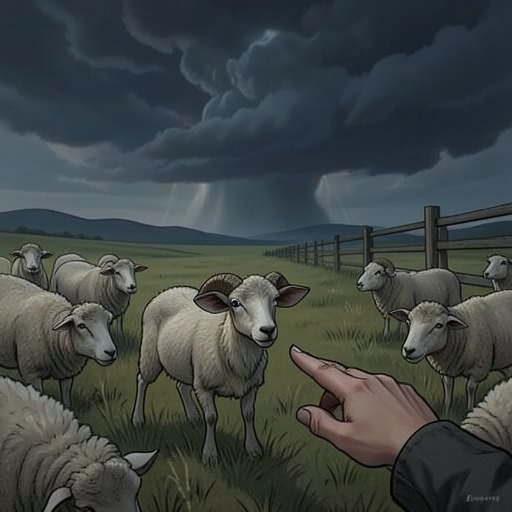
Three Bags FullMopple the Whale is the flock’s memory sheep, a stout Merino ram with round spiral horns and an appetite that continually shapes his attention. He never forgets what he has seen, and this seemingly simple gift becomes essential to the investigation of George Glenn’s murder: Mopple can preserve what others overlook, supply Miss Maple with details Sir Ritchfield has lost, and help translate a sheep’s way of recognizing people into evidence a human audience might understand. His memory is formidable, but his character is not merely a repository for clues. Hunger, fear, curiosity, and attachment to the flock repeatedly compete for his attention, giving his reliability a comic, physical, and ultimately consequential form.
Identity and Temperament
Mopple’s defining trait is his memory, but the novel makes it inseparable from his body. He is very stout and almost always hungry; even a moment of danger may be interrupted by the need to find grass. His appetites are not incidental jokes. They lead him to notice particular smells, help him identify a possible destination, and sometimes threaten to distract him from what the flock needs him to remember.
He is proud of his role as the memory sheep, yet he is also prone to strain and panic. When Miss Maple asks what he is supposed to remember, he answers that it is everything. That answer expresses both his confidence and the burden of his position: he is expected to retain what the flock cannot afford to lose, even when his own attention is pulled toward food or fear.
Memory in the Investigation
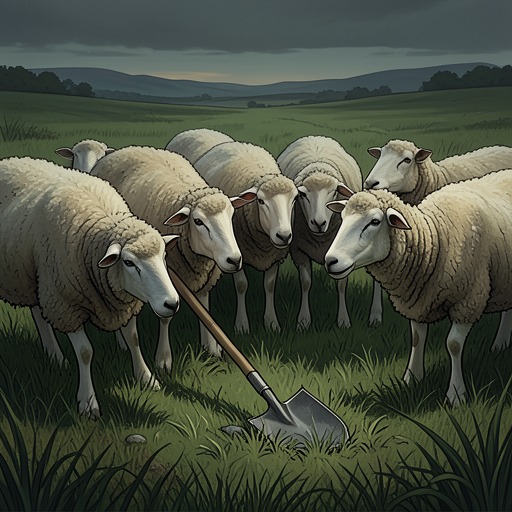
After the flock decides to investigate their shepherd’s murder, Miss Maple takes the lead in examining George Glenn’s body. Mopple waits with the others while she circles the body, inspects the spade, and comes back with blood on her muzzle. He is unable to bear the suspense and asks for her conclusion. Miss Maple confirms that George is dead, then warns the sheep to watch what humans do and avoid gathering suspiciously around the body. The contrast establishes their different investigative functions: Maple interprets the scene and directs the flock; Mopple is the one expected to retain what they learn.
That division becomes explicit when Maple asks the sheep to voice their questions. She stands with Mopple beside her and nods whenever she considers a question worth keeping. He memorizes it, turning the flock’s scattered puzzlement into a store of shared inquiry. Memory here is not just personal recall. It becomes a way of organizing collective attention.
Mopple later remembers an observation made by Sir Ritchfield on a hill. Sir Ritchfield had seen four men—Gabriel, Josh, Lilly, and the butcher—leave together, and one of them lag behind and bend down, perhaps to pick something up, put something down, or tear up a tuft of grass. Then Sir Ritchfield sneezed five times and forgot which person had bent over and what they had held. Mopple preserves the outline of the incident, including the gap in the evidence. He also recalls that Sir Ritchfield knows he has forgotten something and is trying to stop Mopple from revealing it. Mopple likes and respects the lead ram, but concludes that the missing action may be a clue and brings it to Miss Maple. His memory does not magically resolve the mystery; it keeps uncertainty intact long enough for the flock to examine it.
Appetite, Senses, and Fear
Mopple’s hunger sometimes threatens to divert him from investigation. When he secretly squeezes through a narrow gap in the hay barn, he has a serious reason for wanting to reach Miss Maple: he has remembered a clue, and suspects Sir Ritchfield may try to prevent him from sharing it. Yet the immediate physical difficulty—the splinter pressing into his side—makes him fear that he will panic, forget everything, and die of starvation before he can get through. Once outside, he finds misty grass so appealing that he postpones looking for Maple and grazes until he is less hungry.
In the mist he encounters the spade left where Tom O’Malley had assembled the human flock. Mopple notices that it has fallen over and judges that human tools belong in toolsheds. Its smell, however, does not match his usual understanding of such tools. He detects only a faint human scent, then follows its developing traces: soapy water, whiskey, cleaning fluid, a rancid beard, and unwashed feet. He realizes that he is no longer smelling the spade but a human moving nearby. Unable to see the figure clearly, he loses his nerve and gallops away. The episode makes scent an investigative instrument while showing its limits: the smell alerts him to a presence, but mist obscures what his eyes might otherwise confirm.
Fear does not wholly incapacitate him. Under an old lime tree, Mopple stays put when men and the butcher arrive. He recognizes that running away has not helped before, so he continues chewing and memorizes what they say. More strangely, he perceives their fear as a separate, animal-like presence, larger than a sheep and moving on four legs. Rather than identifying with it, he observes it as something belonging to the men. When evening comes, however, what he wants most is to return to the flock. Remembering the route he took through the mist, he trots home. His courage is practical rather than grand: he learns when staying still is useful, and when the flock is where he needs to be.
A Memory Put to Work
Mopple’s appetite also contributes to the flock’s plans. When the sheep struggle to work out how to find a takeaway, he mentions that takeaways have chips. George had once given him a fried potato to demonstrate that he would not like it, but Mopple remembers its smell and taste. Since he is the only sheep in the flock with that experience, Miss Maple recognizes that he can serve as a kind of food-sensing guide. His knowledge comes not from abstract reasoning but from a remembered encounter that his appetite has made unusually precise.
Later, Rebecca finds grass beneath the dolmen. Mopple becomes so intent on tasting it that, while Rebecca sits in the dark, he darts to the open packet and eats its contents before she notices. He is disappointed: the grass smells better than it tastes, and is less appealing than meadow grass or hay. The incident gives his curiosity a limit. He resolves not to eat unfamiliar things again, a conclusion that is characteristically grounded in taste rather than danger or principle.
Melmoth’s attention exercises test the same combination of strengths and weaknesses. The sheep practice walking along the cliff tops while noticing every step, and are sent to steal Gabriel’s rain-soaked shepherd’s hat from the caravan steps. Mopple learns that close attention can leave little room for fear, but during a mock attack he concentrates so hard that he forgets to dodge and is run down. His memory and alertness are powerful capacities, not effortless mastery; attention has to be directed, and it can become a hazard when it excludes the immediate need to move.
The Reenactment and Narrative Role
At the Smartest Sheep in Glennkill contest, Mopple’s remembered knowledge becomes part of the flock’s attempt to make its account of George’s death legible to people. He joins the performance carrying a rag whose smell will represent the murderer’s scent. He knows his role and has remembered what to do, but freezes when he sees the butcher in the front row. The encounter turns performance back into danger: the evidence is no longer being rehearsed privately among sheep but presented before a human connected to the case.
The rag is the result of careful experimentation. Mopple argues that humans, who have noses, must be able to detect some scent, even if their sense of smell is poor by sheep standards. Maude finds a faint, sour smell on a rag in the toolshed. The sheep strengthen it by burying the rag in dirt, covering it with chewed sorrel, and wrapping it around a recently dead shrew. The resulting smell is not identical to Beth’s, but the flock recognizes the similarity. Mopple carries the rag close to Miss Maple as she presents the chain and cross that represent Beth’s pendant. His contribution turns an invisible clue into a theatrical sign the audience might perceive.
The scene gathers Mopple’s most characteristic qualities into one action. He has remembered the role, helped reason out how scent might communicate across species, and followed the flock back onto the stage after briefly leaving it for cake. His appetite remains present even at the climax, but does not finally displace his responsibility: he drops the cake and returns when the performance needs him. As the flock’s memory, he is not simply a comic observer or a storehouse of facts. He is the link between fleeting observations and a shared account—one that the sheep can stage, examine, and offer to human beings who do not naturally inhabit their sensory world.